
Exhibition
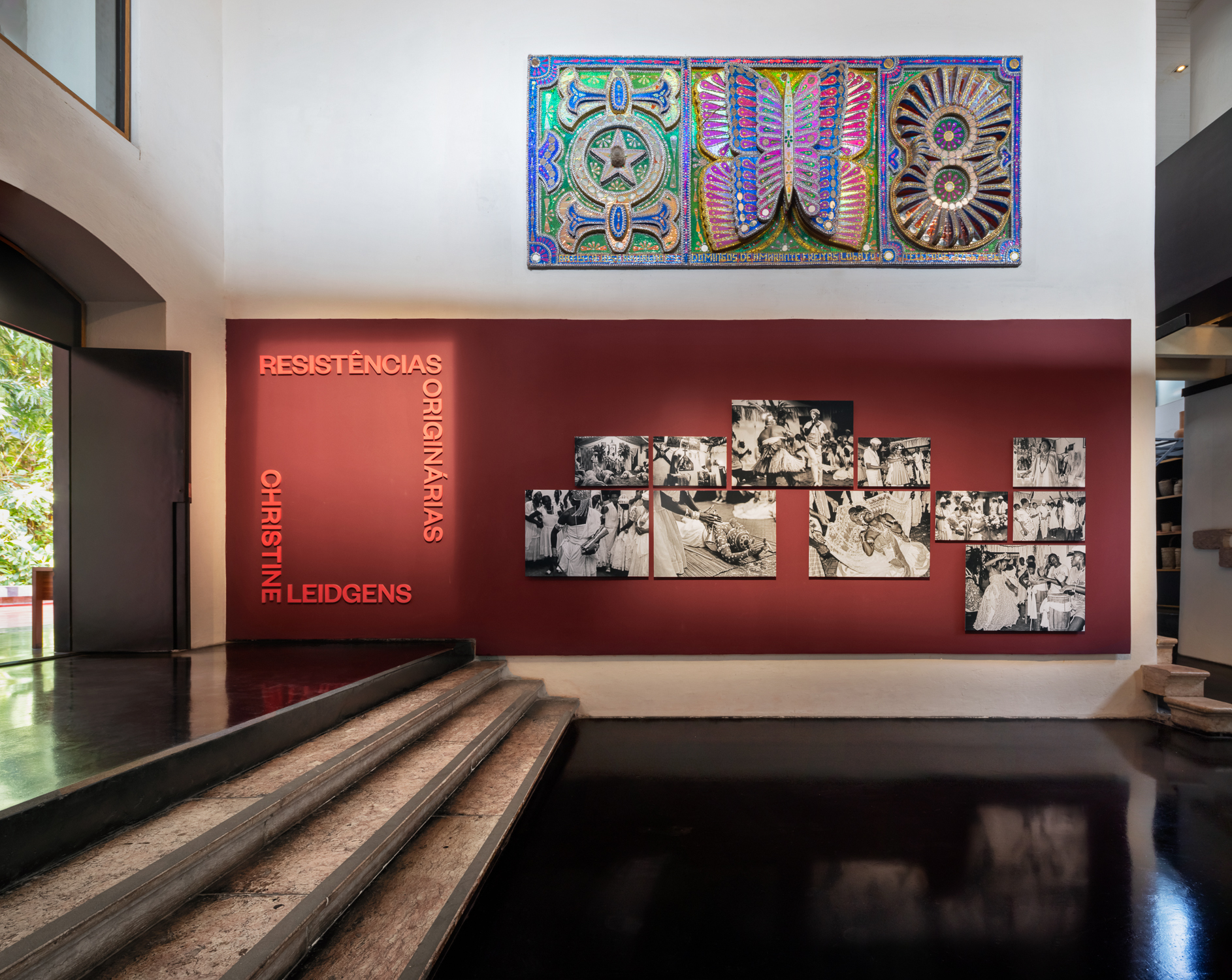
Original Resistors

Christine Leidgens’ work is a territory of encounters and permanence. With depth and respect, it records ways of life rooted in the direct relationship with the territory and the preservation of collective memories. Through decades of work in Latin America, Africa and other countries, the photographer has built a collection that goes beyond the documentary function, establishing a field of dialogue between cultures, stories and landscapes. The exhibition brings together images captured in different contexts: indigenous workers from Bolivia; quilombos and black villages from the Amazon and Africa that keep their ancient traditions alive; the Piaroa people, in Venezuela, with their knowledge about the sustainable use of the forest; all protagonists of a history marked by struggle and community organization. In all these meetings, Leidgens produced portraits that value cultural diversity and reveal the complex web of relationships that underpin life in these territories.
Each series in the exhibition highlights the capacity of communities to articulate past and present in everyday practices, resisting external pressures and reaffirming identities.
Whether in the movement of popular festivals, in the precision of the artisanal techniques, in the work routine or in the gesture of sharing, their images reveal that culture is a central element of continuity and transformation. By combining artistic sensitivity and documentary rigor, Christine Leidgens offers the public an opportunity to recognize the authorship of these peoples in the creation of worlds, languages, and knowledge.
The Vale Cultural Institute is pleased to welcome visitors and share these precious images, inviting them to immerse themselves in the world of Christine Leidgens and to recognize, in each photograph, the strength of those who insist on originating the world every day.
Good visit!
Vale Cultural Institute

For a committed and autonomous vision
What is Humanity? It’s a predicate that things have in common when viewed as photos
.
Susan Sontag, About Photography
Photography is a Western invention. It, like the watch, phonograph, or computer, is part of the elaborate chain of values and relationships with memory that made the West what it is. To better understand the photographic vision in the chain of history, we can talk about the choice and the advancement of the machine; about the need for the fixity of time, which contributes to the dissection of ethics into morals; about the need to produce historical facts for the historiographic logic of organizing memory; and about the great demand for verisimilitude, as a sense of reality, for a world governed by the eternalization of the latter, that is, by death in life. We must also not forget the supremacy of control and persuasion through the image. Realistic representation and dissemination, as a broad spectrum of mediation, are values esteemed by the West and pursued in all their forms. They make it possible to create an environment that overlaps the real one. In the world governed by images, what is represented gains hyperbolic value, assuming control over the truth of things. A photo of a flower becomes more of a flower than the flower itself. That’s right, as long as we opted for the icons.
It is common to bring the click of the camera closer to the shooting of a revolver. There is fear and apprehension in the face of the certainty of having been captured in an image. At that moment, we felt the first astonishment at the possibility of recognizing our own image. There’s always a part of us that goes away. The act of being photographed is a surrender, and that is why anger haunts all those who have their image stolen or poorly projected. No wonder, indigenous people of various ethnicities believed that their souls were kidnapped when they were photographed for the first time. Like someone about to be executed, in front of the cameras, we experience the same space-time suspension. Final fear floods the expectation of who and how, as a spectator, will take our sacrificed part. If, on the one hand, the eyes behind the lenses cut out, distort, edit and objective, on the other hand, they reveal what is inside things. The photograph, as Benjamin rightly puts it, de-ritualizes to be exposed in communication.
Thus, it is easy to conclude that photography contains in itself a type of vision resulting from the sharing between the processes and limitations of the machine and the set of technical and semantic contours that the photographer creates for the production of each image. It is curious to note the reduction that the photographic mechanism imposes on the human experience of things. As much as we may consider the active eye to decide perception, we cannot highlight the fact that the lens, viewfinder, or frame reduce two eyes into one, catalyzing the paradoxism of the photographic image. Even with the invention of visors that present us with a more final perception of the imaginary intention, we are reduced to the frame, that is, to a single fixed hole, with no possibility of lateral deviation or escape. What the left eye denies the right eye, the photograph focuses on affirmation-denial. Even the most horrendous object, for example, gains beauty in the photographic image. The purest and harshest truth is relativised. The most intense pain is distanced by the quality of what Sontag called embellishment, see the liberalizing alienation of the world.
However, part of the photographic paradox puts us beyond the contradictions, since the images make our eyes clear. For this reason, the exhibition that we offer to you, the visitor, was set up with the purpose of clarifying some facts, maintaining loyalty to the desire expressed by Christine Leidgens at each click. She says that her mother scolded her, saying, “You’re not going to change the world”! However, the recognition of those who saw his images said the opposite. With admiration, it is easy to identify ourselves in projection on the objects and subjects portrayed. Images don’t change the world at all, but they have the capacity to hold us responsible, in some way, for what we see and know through them, if not before the other, at least before ourselves, before life.
Christine Leidgens is a photographer who, from a Brazilian perspective, belongs to the third generation of traveling photographers, which means being part of the group of those (not feminine, since it was a generation of women) who, in addition to the mere expeditionary and exoticist record, decided to immerse themselves in living with the communities portrayed, proposing new forms for photojournalism and, especially, for the transmission of photographic work. In the case of Christine, we can say that the photographer worked as a transitional link, since, in her permanence in the midst of the original peoples (Afro-indigenous communities), she allowed the baton to pass so that, today, the communities themselves can produce their recording images.
Although not in a direct and intentional way, the close contact with the subjects portrayed, as well as Leidgens’ participation in everyday activities, established a double flow of exchanges and opened the possibility for experimentation and interest in the photographic technique. The most striking example of this movement is the founding of the Quilombo do Frechal Photographic Space, which consists of a quilombola house dedicated to imaginary memory, maintained by the community and for the community.
Christine Leidgens’ work, as well as the experiences she relates in stories about her visits to the places she photographed, highlights the specific role that photography plays for indigenous communities, especially in the Latin American context. Historically, each of these peoples had to fight to guarantee the right to land and better living conditions, making use, above all, of cultural resistance, which attests to the condition of originality and originality of each group. Photography, dominated by them, by their own hands, bequeathed by the photographer, was configured as a powerful weapon for reactivating memories and recognizing their central place in the political game, as agents that create autonomy.
Original Resistors
Of all human issues, perhaps the struggle for land ownership – linked to the essential and urgent need for the production of culture and, in turn, for autonomy – is the oldest and most permanent. The exhibition Original Resistances offers, in the public eye, the blatant records captured by Christine in six original indigenous and black communities. The common thread is cultural insurgency, the fruit of the relationship with the land. Due to the spatial availability and the emphasis of the chosen narrative, we decided to separate them into two comprehensive cores, grouping series by similarity or contrast. From the outset, the visitor is flooded by the images taken at the Tambor de Mina and Candomblé yards, in Maranhão, more specifically in São Luís. We decided to start with the images of the place that highlight the importance of culture in the reinvention of traditions through living memory.
Then, this room contains photographs of two communities that, because they have managed to remain completely autonomous, are brimming with joy and life force. This is the case of the Quilombo Pioneiro de Frechal, in Maranhão, which has always been born of the desire for freedom and of doing life for itself; and the indigenous Piaroa community, from Venezuela, which, on the margins of the State and institutions, has found ways to perpetuate its own agency. Both communities are exemplary and attest, once again, to the importance of autonomy to reverse the crime of coloniality.
The second room houses groups representing social groups that have had more diverse histories of resistance: the black communities of Ecuador, Benin, and a mining community in the Bolivian Altiplano. San Lorenzo and El Chota offer us records of two black Ecuadorian populations that, occupying opposing landscapes – the literal and the mountains – remained faithful to their origin, producing the culture that became a national symbol, as is often the case. In the group dedicated to Benin, we see how much the cult of Voduns, which greatly contributed to Afro-Brazilian expressions, remains the formative body of the subjects that inhabit the country. Finally, the portraits of indigenous Bolivians offer us a precise, hard and melancholic counterpoint to subjugation by the State and the perpetuation of colonial patterns of material poverty. Even so, the sharp images testify to the force of popular thought that is urgent and bursts with power and natural forces.
The photographs may not change the world, but they bear witness to those who tried to do it on a daily basis, elbows united, in autonomous practices. Christine Leidgens’ photographic vision, in this moment of discursive choice and exhibition, can, if we want, share our eyes. This coming and going of the eye, the suspension placed before the images, the distance and the approximation of the realities portrayed, invite us to erode what we have inside, inspiring us, in invitation, to solidity, freedom and autonomy.
Gabriel Gutierrez
São Luís, August 12, 2025

BRAZIL QUILOMBO DE FRECHAL

Quilombo de Frechal: Original Black Territory
Quilombo is an original territory par excellence, because, founded on the relations established between former libertarian enslaved and their land of habitation and survival, it inaugurated a new way of living. Land is the legacy of the original condition, as in the case of Brazilian indigenous communities that, despite the imposition of colonizing marginality, continued to produce culture as a form of resistance. Quilombo de Frechal is located in the municipality of Mirinzal, in Maranhão. The territory of Maranhão contains more than 2,025 quilombola communities, making it one of the important centers of struggle for the rights of black communities in Brazil. Frechal was the first quilombola community to gain official recognition for land occupation, after intense community mobilization. The demarcation of the territory of Frechal represented, in addition to a legal framework, the intensification and renewal of claims for reparation policies that today impact dozens of other quilombola and extractive communities in the country.
Frechal’s visibility and legitimation process was directly linked to the actions of its residents, as well as to the support of other local leaders, activists, and artists committed to quilombola causes. Among them, photographer Christine Leidgens, who lived in the community for six years during the 1990s, recorded the daily lives of Frechal residents in the photographic series entitled Frechal, a Pioneer Quilombo in Brazil: from slavery to the recognition of an Afro-descendant community.
The images, captured by the artist, accurately document aspects of daily life, land work, faith, festivities, and community bonds.
Leidgens’ photographs, in addition to their visual and aesthetic testimony, directly contributed to the creation of the Quilombo de Frechal Photographic Space, the first of its kind in Brazil, which directly favored the preservation of quilombola memory and the struggle to win the title of Extractive Reserve, granted by the Brazilian government in 1992.
By recording Frechal in its complexity, Leidgens highlighted the central role of cultural activity in building resistance. Understanding black communities as original producers of symbolic value shows that the right to physical territory overlaps and confirms the right to exist based on their own and autonomous logic. Christine’s images recognize culture as an instrument of organization, cohesion, and territorial defense, guaranteeing the solidity of the social structure of permanence on earth.
Frechal is an example of Brazilian cultural formation, a process that does not begin in institutional centers, but rather in the margins, based on black, indigenous and popular heritages, witnessed by ancestry. It is the practices of these populations that make up the main elements of the imaginary, knowledge, and customs that define the country. In this sense, Frechal is not an exception, but a synthesis.
Gabriel Gutierrez
São Luís, July 2025
“Palm trees are born of nature, they don’t fall down, they are blessed” – Berinha
A people that does not guard or cultivate its memory is a dominated people.
The word FRECHAL means wooden beam on which the roof structure of a house rests. Figuratively speaking, the blacks of Frechal represented, in the past, the mastermind that supported the Coelho de Souza farm, making possible the struggle of the remaining quilombo communities for the right to citizenship;
making possible the struggle of the remaining quilombo communities for the right to citizenship. Today, Frechal is a reference for autonomy and resistance
.
The women of Frechal played a central role in cultural and territorial resistance.
The scene was set! It was the beginning of a long and thorny journey, from which the pioneering community emerged victorious by recognizing the quilombola territory in Brazil”. C.L
“As soon as I arrived in Frechal, on the anniversary of the Residents Association, I learned, with amazement, that Duzinha’s house had been set on fire the day before by the farm’s henchmen. While the glow of the lamps vibrated in the darkest corners of the residents’ homes, electric light radiated from the said owner’s mansion.
The family economy in Frechal remains based on the community use of natural resources. Currently, other sources of income are added to this practice, with the presence of teachers, entrepreneurs, and public servants who work in neighboring cities. Today, the community has the Photographic Space, the Tempero da Casa restaurant and the office of the Chico Mendes Institute (ICMBio). It can also be seen that the population has been updated in terms of communication, using cell phones, online training and social networks, integrating with the contemporary world.
Land should not have owners; we are merely guests of life, responsible for caring for it and respecting its continuity.
The concepts of quilombo and quilombola were redefined, ceasing to refer only to fugitive enslaved groups from the past. Currently, they now designate land occupied by people of African descent, recognized as an instrument for the preservation of the country’s identity and
natural wealth.
Currently, the National Historical and Artistic Heritage Institute (IPHAN) works to value Frechal’s heritage, through the registration of the quilombo, a fundamental instrument for the protection of its cultural assets, the dissemination of actions and the strengthening of the community in the defense of its knowledge and territories.
“He wanted to put us in the Sertãozinho, we said: he’s the one who’s going there, to hell!” – Little help
The calendar of festivities in the community of Frechal is confused with the liturgical calendar of the Catholic Church and with popular religion, integrating cults for saints, promises, litanies, rosaries, shepherds, Congo dances, the Creole drum in honor of Saint Benedict, patron of the community.
The various Afro-Maranhão rituals guard and connect African and indigenous cultural and religious values. They are a living ancient force, guardians of Afro-indigenous memory
that promotes autonomy.
VENEZUELA - PIAROÁ INDIGENOUS LAND

Christine Leidgens: A Visual Testimony of Memory and Resistance
When Christine Leidgens arrived in Venezuela in the early 1990s, she was driven by a genuine commitment to indigenous communities. His integration into the Center for Education and Promotion for Indigenous Self-Management (CEPAI) was the result of his extensive work experience at Quilombo Frechal, Brazil. However, his work in Venezuela took on a unique dimension as he became a silent and profound witness to the efforts of the indigenous Piaroa of Chavaichinoto in the production of Patauá oil.
Unlike other volunteers who arrived with pre-defined roles, Christine immersed herself in the everyday life of the community, allowing her work to flow at the pace of the people. The mission was not to intervene or advise, but to record, with its lens, every detail of an ancient process, carried out with techniques transmitted from generation to generation. From the collection of the fruits to the pressing and filling of the oil, Christine documented some of the steps, without imposing external structures, just following the natural course of the Piaroa’s work.
The artist’s integration into the Chavaichinoto community was authentic. The inhabitants welcomed her with confidence, and during their time together, Christine not only recorded images, but shared moments, learnings, and challenges. The photographs taken with the Piaroa people, in addition to the technical processes of community work, reflected the spirit and ceremonies of a people who, despite outside interference, knew how to maintain their identity and autonomy.
More than a visual testimony, the photographic collection is proposed as the memory tool that allowed the Piaroa to analyze environmental, technological, and cultural changes in their community.
The occasion of the exhibition of Christine’s work in Chavaichinoto was a moving event. For many residents, it was the first time they contemplated their own faces in detail, a transformative experience for those who, by custom, rarely used mirrors. Elderly, young people and women found, in their photographs, a reflection of their spirituality and identity, a link with the past and a reaffirmation of their cultural resistance.
Over the years, the collection has passed through various institutions, such as the Amerindian Cause Foundation and the Orinoquia Foundation, where it remains in custody and permanently exhibited in Caracas. However, the Piaroa of Chavaichinoto expressed the desire for the images to return to their community, where they wish to rediscover the visual legacy that Christine helped immortalize.
More than 30 years later, this work remains a testament to the living history of Chavaichinoto and a tribute to the resilience of the Piaroa. The images not only capture an instant in time, but transform the past into an eternal present, reaffirming the value of ancient knowledge and the strength of a people determined to tell their own story.
Hernán Francisco González
Caracas, April 25, 2025
Located in the municipality of Ceden, in the state of Bolívar, the Piaroa community of Chavaichinato continues to preserve its territorial autonomy and remain culturally firm.
“I still remember the view, from heaven to earth, of a house with a big pointed hat in the middle of the Amazon rainforest, like a fairytale landscape where our plane would land. Greeted with kindness by the assembled villagers, they called me a “squirrel”. I thought they were going to choose a big animal!” C.L.
The body paintings represent links with the spirits of the forest, fields, and rivers. Some designs are used in initiation ceremonies for girls and boys
.
At the heart of the Venezuelan Amazon, in the state of Bolívar, lies the remarkable Indigenous University of Venezuela, whose promoters and managers are the communities themselves. It revitalizes the culture of indigenous peoples, guarantees the sovereignty of their spaces, promotes endogenous development and respect for nature
.
Indigenous people practice a self-sustainable economy that honors the abundance of the land. They cultivate cassava, corn and other tubers, collect fruits, patauá and cacao, in addition to hunting and fishing
.
The Piaroas are an inseparable part of the forest, more than just inhabitants. Their knowledge and rituals bear witness to a vision of the world that resists and intertwines human beings with nature, in a web of reciprocity
and respect.
Ancestral ceremony held annually, with offerings, requesting good harvest and health for the entire village.
Although cacao is currently the main economic resource, el seje or patauá, famous for its oil, is still harvested and benefited by the community. Knowledge about the production of Patauá oil is transmitted from generation to generation. This oil not only nourishes but also heals.
ECUADOR - SAN LORENZO AND EL CHOTA

Black Equator: San Lorenzo and El Chota
The black presence in Ecuador dates back to transatlantic trafficking, which, between the 16th and 19th centuries, transported millions of enslaved Africans to the Americas. Although Ecuadorian territory was not a central destination in this circuit, there are records of three migratory waves that marked the arrival of black populations to the country.
In the mid-16th century, the Spanish ship La Concepción, in 1553, carrying enslaved Africans between Panama and Lima, was wrecked off the Esmeraldas coast. The survivors took refuge in the region’s rainforests, where they organized autonomous communities, known as palenques. Led by figures such as Alonso de Illescas and Andrés Mangache, the communities, in alliance with the region’s indigenous peoples, gained such strength and autonomy that, in 1599, they forced the Spanish crown to recognize their local authority. Thus, the Republic of the Zambos de Esmeraldas, one of the first examples of Afro-indigenous political organization in America, was consolidated.
Already at the end of the 17th century and throughout the 18th century, many enslaved Africans arrived in Ecuador brought from the port of Portobelo, present-day Panama, by the Society of Jesus. These groups were taken to work in the Jesuit sugar, cotton, and cattle ranches located in the Chota Valley and along the Mira River, in the present-day provinces of Imbabura and Carchi. Ethnic groups such as the Carabalí (originally from the regions that today make up Nigeria and Cameroon) and the Congos arrived in Ecuadorian territory between 1690 and 1760. With the expulsion of the Jesuits in 1767, about 2,600 Africans remained on these properties, giving rise to the current black communities in the north of the Ecuadorian highlands.
The third wave of migration occurred at the beginning of the 20th century, linked to the construction of the Transandine Railway, which would link Guayaquil and Quito, crossing the Andes. About 4,000 blacks, mostly Jamaicans, were hired as laborers. Many of them remained in the country after the work and settled in Durán (Guayaquil).
In the 1980s, French-Belgian photographer Christine Leidgens toured these two regions and recorded the daily lives of these black populations in Ecuador. The images reveal the photographer’s careful look at everyday life and her affections. From work gestures to family ties, from parties to domestic spaces, the photographs of San Lorenzo and El Chota form a rare record of Andean and coastal blackness, produced at a time before the adoption of specific public policies for Afro-descendant populations in the country.
In Leidgens’ images, Afro-indigenous culture asserts itself as the foundation of autonomy and resistance. The communities portrayed, which respond in their relationship with the landscape, overflow their own aesthetics, revealing ways of living linked to the creation of open, free traditions linked to African ancestry. Music, for example — with the presence of the marimba corralao on the Pacific coast and the rhythm of the bomb in the Chota Valley — is a living expression of African ancestry. By capturing people in their places, in the layers of social life, Leidgens reveals the origin of the senses of things and of the world, a portrait of what is most human. Between memory and vital reinvention lies the daily, everyday and joyful affirmation of existence.
Gabriel Revelo
Quito, July 2025

“I still remember this unique and unique wagon, like the ghost trains at amusement parks, which made us discover, zigzagging at every curve, the secrets of this dazzling forest. Departing from the city of Ibarra, we stopped at the isolated villages of the world of the El Chota Valley, until the end of this path…
There, at the end of the world, the sea and the unlikely encounter with San Lorenzo. It was the first time I actually encountered the joy and freedom of black communities. My soul union was instantaneous.” C.L.
SAN LORENZO
THE CHOTA
BENIN - FROM THE STREETS TO VODUM

Benin vs. Brazil
The visitor will be able to verify, by appreciating the images presented here, the resistance, the connection and the rapprochement of the different human bodies originating from two continents: Africa and America. Despite the differences, historical similarities bring these people closer together and connect them in the fight against the colonizer. On the one hand, the territories of the original peoples of the Americas were invaded, their populations decimated by the millions, their histories and identities denied and destroyed. On the other hand, most of the inhabitants of the Republic of Benin arrived in the Amerindian territories to be enslaved, like these, to have their natural riches, histories and identities plundered, denied and destroyed. Both sides of the Atlantic resisted in defense of their liberties, dignity, and cultural identity. In addition to the discourses and written texts, which tend to abstract the physicality of these populations, the exhibition Original Resistances proposes to recover the concrete value of the struggle of each of them.
The images serve as historical documents of these bodies, arousing the attention of those who have never seen or known them. What an impact! Faced with images, universes of multicultural and multiracial exchanges open up, which not only remain in the realm of the senses, but contribute concretely to liberating education, revealing the undeniable struggle that each community body undertook for its own freedom. In the process of building a liberating education, in accordance with laws 10,639/03 and 11,645/08, which make it mandatory to teach African history and culture, of people of African descent and native peoples, this exhibition offers teaching material of undeniable quality.
Kabengele Munanga
São Paulo, May 01, 2025


“Stepping on the land of Frechal’s ancestors haunted me… I was transported to Benin”. C.L.
An
animist cult born in the ancient kingdom of Dahomey, Vodum embodies a deep connection with nature, ancestors, and invisible forces. Benin’s cultural heritage, Vodum has been officially recognized as a state religion since 1996 and continues to play a vital role in Benin society to this day. It is omnipresent in everyday life.
BOLIVIA - 20TH CENTURY MINE

Siglo XX, today!
Between 1984 and 1985, Belgian photographer Christine Leidgens documented the daily lives of workers at the Siglo XX mine in the Bolivian highlands. Located in the middle of the Andes, more than 4,000 meters above sea level, the mine was one of the main centers of tin extraction in Bolivia in the 20th century. Nationalized after the Revolution of 1952, the mine came under the control of COMIBOL (Bolivian Mining Corporation), the state responsible for managing production and also the living conditions of the workers.
In the midst of the stone mountains, the crowd of workers, mostly indigenous, merges with the landscape, whether in everyday life, in the struggles for better living conditions, or in the suspension of the portraits captured through Christine’s lenses. Among the characters in this mineral scenario, we can witness the eyes of formal contractors, contractors (paid per task), tenants (who rented decommissioned wells), lameros (who filtered mineral waste), venerists (who excavated their own galleries), and jucus (who sold illegally extracted ore). Everyone was imbued with a work that imprisons and frees, in a constant balance between resistance and conformity.
The presence of women was fundamental both in the family environment and in the political organization of the community. Most of them worked like palliris, manually selecting stones that still contained traces of tin, an exhausting and low-paid job, generally undertaken by widows or single mothers.
The awareness that the exploitation extended from the worker to the entire family led to the creation of the Housewives Committee (Committee of Housewives), one of the main forms of collective mobilization at the time.
The committee became a space for political coordination, denouncing exploitative conditions and demanding basic rights for workers’ families. The figure of Domitila Barrios de Chungara, labor leader of the 20th century, became a symbol of female participation in the mobilizations of the Bolivian working class.
In addition to their productive and political role, women also guaranteed the preservation and transmission of Andean cultural practices and rituals, such as the offerings to Pachamama, during syncretic cults held inside the mine itself. His actions, simultaneously domestic, economic, religious and militant, were decisive for social cohesion in an environment marked by extreme working conditions and successive military repressions that permeated the entire history of the mine. Even after the nationalization, the Army violently intervened in the strikes and mobilizations, as occurred in the massacre of June 24, 1967, during a feast of Saint John.
The history of Siglo XX can be read through the looks, skins, clothing, gestures, and silences represented in Leidgens’ photographs. The precarious reality is addressed by the record of the struggle for rights, which, although hard and dry, is presented, not as a spectacle, but in an affirmative way, expressed in the traits of those who, despite everything, continue to hold on to life for themselves and for the other.
Gabriel Gutierrez
July 2025


In the SIGLO XX camp, miners and their families live in precarious conditions: cramped houses, without drinking water or basic sanitation. Cabins, schools, hospitals, shops and water points belong exclusively to COMIBOL (Bolivian Mining Corporation), the state company that owns the mines and manages the camps
.
380 km from La Paz, the capital of Bolivia, the SIGLO XX mine became a symbol of workers’ resistance and the struggles of miners, in a country whose underground mineral wealth paradoxically contributed to the extreme poverty of most of its population.
Despite the industrial diversification of mining in Bolivia and the decentralization of COMIBOL in 1986, this state company remains active, maintaining an important role in the economy and management of the country’s mineral sector.
“Coming from Cuzco on my way to Bolivia, I have in my hands the book by Domitila Chungara, which a friend delicately packed in my suitcase before my departure to Belgium. Finally mastering Spanish, I immersed myself in it. I was absorbed, permeated, impacted and, without any deviation, it led me to the 20TH CENTURY. I had to see with my own eyes the aridity of the landscape, the harshness of the life of the miners, their unwavering resistance and the relentless struggle of women against the exploitation of workers, witnessed tenaciously in the book”. C.L.
In the 20th century, tin mining surpassed silver mining in economic and strategic importance.
For 35 years, the miners of SIGLO XX were at the forefront of the Bolivian working class. Strongly organized and combative, they repeatedly faced state repression, becoming an example and inspiration for workers from other sectors,
including the peasant movement.